A business loan declined decision can put pressure on cash flow, supplier payments, hiring plans or growth projects. It can also feel personal, particularly when the business is trading well and the funding has a clear purpose.
The next step is to find out why the lender said no, then decide whether to improve the application, change the type of finance, reduce the borrowing amount or use another route. A declined business loan usually means the lender was not comfortable with the risk, evidence, affordability or product fit at that point in time.
This guide explains why business loan applications are rejected, what to do immediately after a decline, how to protect your credit profile, and which alternative business finance options may be worth comparing.
Important: This article provides general information for UK businesses. It should not be treated as personal financial advice. Always check costs, terms, security, personal guarantees and regulatory protections before signing any finance agreement.
Business Loan Declined: What to Do First
If your business loan has been declined, avoid making several new applications straight away. Repeated applications can create unnecessary credit search activity, and a rushed second application may fail for the same reason as the first.
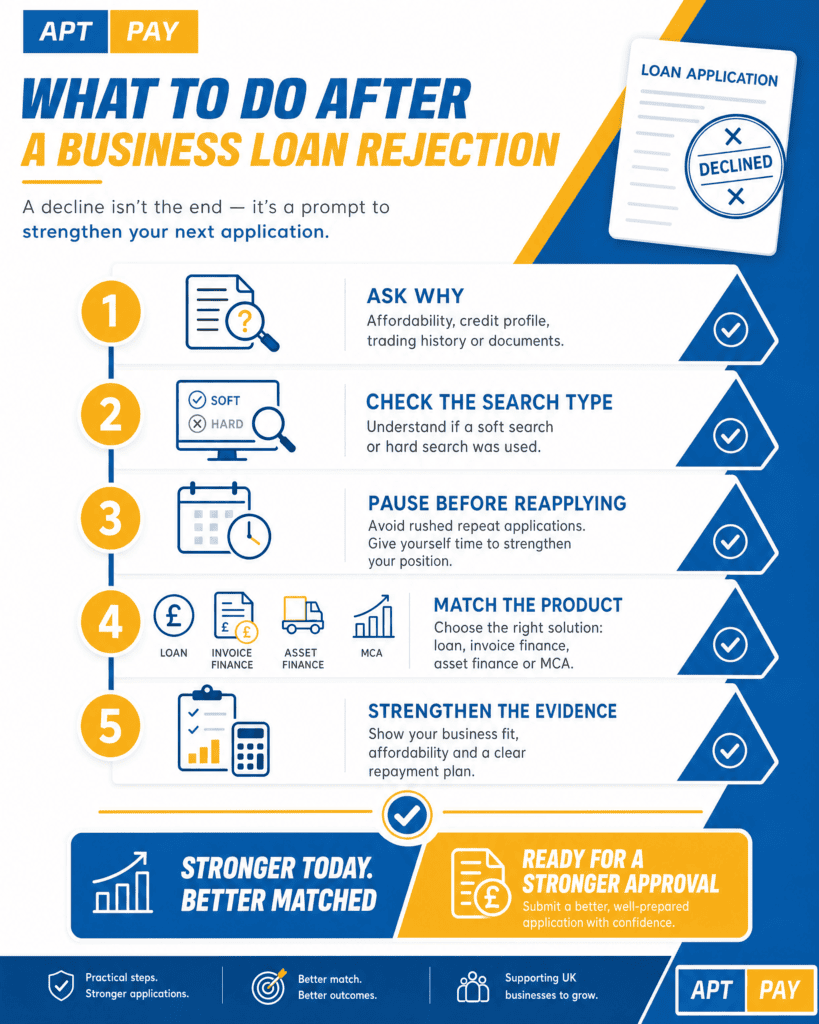
Start with four practical steps.
- Ask the lender for the main reason.
Some lenders will only give a broad explanation, but even that can help. The issue may be affordability, trading history, credit profile, sector risk, security, missing documents or product suitability. - Check whether the search was soft or hard.
Soft searches are usually used for eligibility checks. Hard searches may be visible to other lenders and can matter if several are made in a short period. - Pause before changing lender.
A different lender may have a different risk appetite, but the next application should still be stronger than the first. - Match the funding need to the right product.
A standard term loan may not suit every situation. For example, invoice finance may be more relevant for unpaid invoices, asset finance for equipment, and a merchant cash advance for businesses with regular card sales.
A rejection does not automatically mean the business is unviable. It may mean the lender did not have enough evidence, the requested amount was too high, the repayment profile looked stretched or the product did not fit the funding need.
Why Business Loan Applications Are Declined
Lenders assess risk in different ways, but most rejected business loan applications come down to one or more of the following issues.
Credit profile
A lender may be concerned about missed payments, defaults, County Court Judgments, insolvency history, high credit utilisation or limited credit history. For smaller companies, lenders may also look at directors’ personal credit profiles.
The Information Commissioner’s Office explains what credit reference agencies hold, including previous addresses, public records, County Court Judgments, bankruptcy and insolvency data. It also explains that people who believe they have been refused credit unfairly can ask the lender for the main reason and request credit file information from the main credit reference agencies free of charge.
Affordability
A lender wants evidence that repayments are realistic. Weak cash flow, inconsistent revenue, falling margins, heavy existing debt or regular overdraft pressure can all make the application harder to approve.
Affordability is not only about turnover. A business with strong revenue may still struggle to borrow if profit is thin, payment terms are long or existing repayments already take up too much cash.
Trading history
Many lenders prefer businesses with a stable trading record. Start-ups, seasonal businesses and fast-growing companies may be declined because past accounts do not yet show enough evidence of predictable income.
That does not remove all funding options, but it may change the route. Start-ups may need to look at government-backed Start Up Loans, grants, equity investment, founder funding or specialist start-up finance rather than a standard commercial loan.
Missing or weak evidence
A sound business can be declined because the application does not explain the case clearly. Common evidence gaps include:
- missing bank statements
- incomplete filed accounts
- no management accounts
- unclear use of funds
- weak cash flow forecasts
- no explanation of seasonality
- no detail on existing debts
- aged debtor reports missing where invoice finance may be relevant
Lenders need enough information to understand how the money will be used and how it will be repaid.
Product mismatch
A business loan may be the wrong structure for the problem. For example, a retailer needing stock ahead of a seasonal peak may need a short-term working capital product. A company buying machinery may be better suited to asset finance. A B2B company waiting on large unpaid invoices may need invoice finance rather than a new unsecured loan.
Declined Business Loan: Quick Diagnosis Table
Reason for decline | What it may mean | What to do before applying again |
Poor or limited credit history | The lender sees higher repayment risk | Check credit reports, correct errors, reduce missed payment risk and explain historic issues clearly |
Weak affordability | Cash flow may not support another repayment | Rework forecasts, reduce the borrowing amount or consider a product with a better repayment fit |
Short trading history | The lender wants more evidence | Look at start-up finance, grants, equity, smaller facilities or lenders with start-up appetite |
Missing documents | The lender could not verify the case | Build a complete finance pack before reapplying |
Sector risk | The lender has limited appetite for your industry | Use a specialist lender or broker with sector experience |
Wrong product | The funding need does not suit a standard loan | Compare invoice finance, asset finance, merchant cash advance, grants or equity |
Insufficient security | The lender wants stronger protection | Consider secured finance, a smaller amount, asset-backed finance or a different lender |
What Documents to Prepare Before Reapplying
A stronger application usually starts with a clearer finance pack. The documents needed vary by lender and product, but many businesses should prepare:
- recent business bank statements
- latest filed accounts
- up-to-date management accounts
- VAT returns, where relevant
- cash flow forecast
- profit and loss forecast
- aged debtor and creditor reports
- details of existing loans, overdrafts and finance agreements
- explanation of the funding purpose
- evidence of contracts, purchase orders or recurring revenue
- director information and personal guarantee details, if relevant
The application should answer three lender questions: what the money is for, how repayment will work, and what evidence supports the forecast.
Check Your Credit File and Public Records
Before submitting another full application, check both business and personal credit information where relevant.
Look for incorrect addresses, settled debts still showing as outstanding, duplicated accounts, wrongly recorded missed payments, old directorship links or public records that need updating. If inaccurate personal data is being held about you, the ICO explains your right to ask for inaccurate data to be corrected, including how to state what is inaccurate, explain how it should be corrected and provide evidence where available.
Also check Companies House filings. Late accounts can weaken lender confidence. Companies House guidance on late filing penalties states that a penalty is automatically imposed if accounts are late, and that not filing accounts or confirmation statements can be a criminal offence.
This matters for E-E-A-T as well as lending. A finance application should show that the business is commercially active, well managed and able to provide current information.
Use the Bank Referral Scheme, But Keep Comparing Options
If a designated bank rejects an eligible SME borrowing application, the UK Bank Referral Scheme can help the business reach alternative finance platforms. The British Business Bank explains that, with the business’s consent, the bank provides information to designated online finance platforms, which then contact the business and may help find a suitable finance provider.
The participating banks currently listed by the British Business Bank include Bank of Ireland UK, Barclays, Danske Bank, First Trust Bank, HSBC, Lloyds Bank, Royal Bank of Scotland, Santander and Virgin Money.
The scheme should be treated as one possible route, not the only next step. HM Treasury’s consultation outcome on commercial credit data sharing and the Bank Referral Scheme, published in May 2026, stated that the government does not propose legislative change to the Bank Referral Scheme at this stage. Instead, it invited the financial services sector to develop industry-led proposals to improve referrals and SME outcomes by 18 December 2026.
That makes it sensible to compare the referral route with your own lender research, a reputable business loan broker, local business support and product-specific alternatives.
Alternative Business Finance Options After a Rejected Business Loan
A declined bank loan may indicate that a different type of finance is more appropriate. Business.gov.uk explains common funding options for businesses, including grants, loans and equity finance. It also highlights that grants can have long application processes, restrictions and reporting requirements, while loans must be repaid with interest and may involve security.
GOV.UK also provides a finance and support finder for businesses, including grants, loans and regional schemes.
1. Bad credit business loans
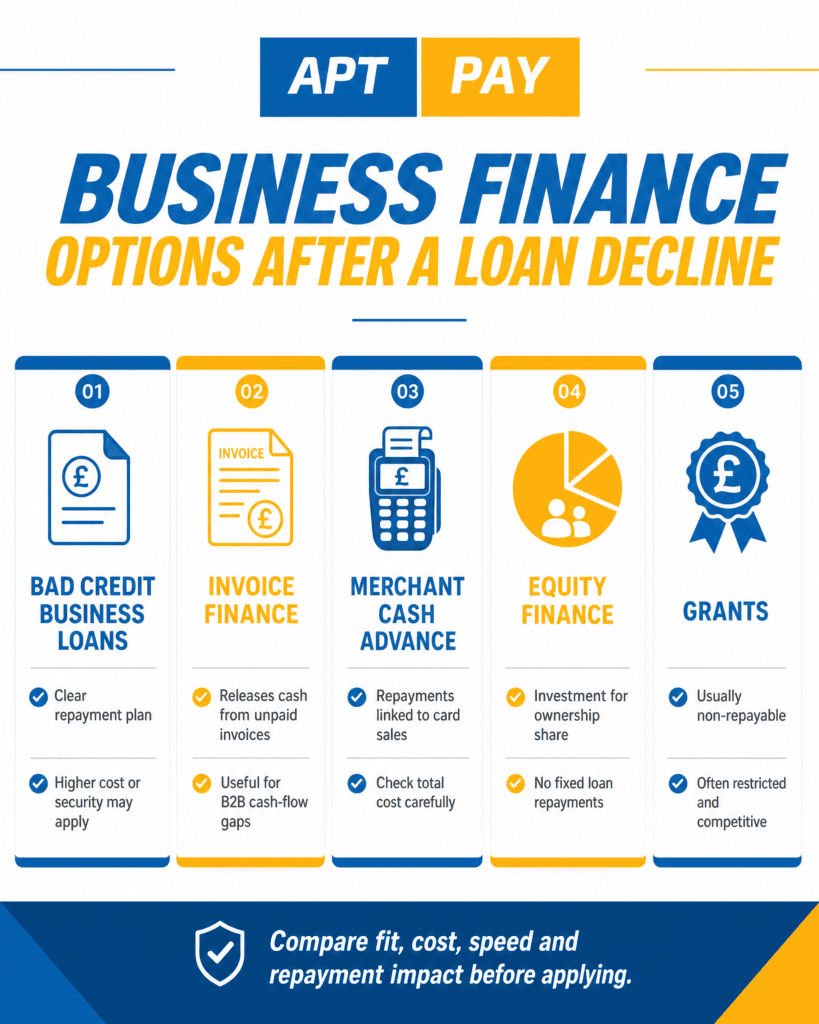
Bad credit business loans may be available where a company has adverse credit, a weak credit score or a previous refusal from a mainstream lender.
These loans can help where there is a clear repayment plan, but they often come with higher costs, smaller borrowing limits, security requirements or personal guarantees. Compare the total amount repayable, arrangement fees, early repayment terms and default charges before proceeding.
2. Invoice finance
Invoice finance can help B2B businesses release cash tied up in unpaid invoices. Instead of waiting for customers to pay, the business receives an advance against eligible invoices.
This can be useful where the underlying business is trading well, but cash flow is strained by long payment terms. Costs, customer contact arrangements, contract length and recourse terms should be checked carefully.
3. Asset finance
Asset finance may be suitable when the funding need is tied to equipment, vehicles, machinery or technology. Rather than borrowing a lump sum for general working capital, the finance is linked to the asset being purchased or leased.
This can improve the fit between the borrowing and the purpose. The lender may be more comfortable because the asset provides security or value.
4. Merchant cash advance
A merchant cash advance may suit businesses that take regular card payments, such as retailers, cafés, restaurants, salons or hospitality firms. Repayments are usually taken as a percentage of card sales rather than fixed monthly instalments.
This can help where income changes from week to week. The main risk is cost. Check the factor rate, expected repayment period, daily deduction percentage and impact on cash flow before agreeing.
5. Community lenders and CDFIs
Community development finance institutions, often called CDFIs, may support smaller businesses, social enterprises and firms that struggle to access mainstream finance. Some operate regionally or focus on underserved communities.
They may also provide guidance alongside lending, which can be useful after a decline.
6. Equity finance and crowdfunding
Equity finance may suit a business with growth potential that is willing to exchange a share of ownership for investment. Business.gov.uk lists equity finance routes including crowdfunding, venture capital and angel investment, and notes that investors take a share in ownership.
The advantage is that there are usually no fixed loan repayments. The trade-off is dilution, investor involvement, legal complexity and future reporting obligations.
7. Grants
Grants can be attractive because they usually do not need to be repaid. However, they are often restricted by region, industry, project type or business stage. They may also be competitive and slow to secure.
A grant may be useful for innovation, training, sustainability improvements or local growth projects, but it is rarely the fastest answer to an urgent cash flow gap.
Personal Guarantees and Regulatory Protection
Some lenders may ask directors or business owners to sign a personal guarantee. This means the individual could become personally liable if the business does not repay.
Read the guarantee wording carefully and take independent advice where appropriate. Check whether the guarantee is limited or unlimited, whether interest and fees are included, what assets may be at risk and what happens if the business defaults.
It is also important to check whether the finance is regulated. The FCA has stated that most SME lending sits outside its remit, including lending to limited companies, LLPs and partnerships of more than three persons. It also states that lending or commercial hire over £25,000 for business purposes is outside its remit.
Before signing, ask the lender or broker to explain what protections apply, how complaints are handled and whether any personal guarantee is required.
When Should You Reapply for a Business Loan?
There is no fixed waiting period after a business loan rejection. The right timing depends on why the application was declined.
You may be able to reapply quickly if the problem was missing paperwork, an incomplete bank statement pack or a simple error. You may need longer if the issue was poor affordability, weak trading history, adverse credit or high existing debt.
A stronger reapplication should show what has changed. That might include:
- updated accounts
- corrected credit file information
- improved cash flow
- reduced borrowing amount
- a clearer repayment plan
- stronger evidence of revenue
- improved Companies House filings
- a more suitable finance product
- additional security, where appropriate
The goal is to send a better application to a lender whose criteria match the business.
Decision Guide: Choose the Right Next Step
Your situation | Best next step |
You were declined because documents were missing | Rebuild the application pack, then ask whether the lender will review the decision |
You need money tied to unpaid invoices | Compare invoice finance |
You need equipment, vehicles or machinery | Compare asset finance |
You take regular card payments and have variable sales | Compare merchant cash advance options carefully |
You are a start-up or early-stage founder | Check Start Up Loans, grants, equity or specialist start-up lenders |
You have adverse credit but stable revenue | Compare bad credit business loans and ask about total cost |
You were declined by a high street bank | Consider the Bank Referral Scheme, alternative lenders and broker support |
You need funding for innovation, training or local growth | Search grants and regional finance support |
You are growing quickly and can give up equity | Consider angel investment, crowdfunding or venture capital |
You are unsure which product fits | Speak to a qualified accountant, adviser or reputable business finance broker |
Common Mistakes After a Business Loan Rejection
Applying everywhere at once
Submitting multiple rushed applications can create search activity and reduce control over the process. It is usually better to apply selectively to lenders that fit the business profile.
Asking for the same amount with the same evidence
If the first application was declined, a second lender may reach the same conclusion if nothing has changed. Adjust the amount, term, security or product where needed.
Ignoring affordability
Funding can solve a short-term problem but create a larger one if repayments are unrealistic. Stress-test repayments against slower sales, late customer payments and rising costs.
Comparing only the headline rate
The cheapest headline rate may not be the cheapest overall facility. Compare arrangement fees, broker fees, personal guarantee requirements, security, default charges, early repayment terms and the total amount repayable.
Overlooking public information
Lenders may review public records, including Companies House filings. Keep accounts, confirmation statements and registered details current.
How a Business Loan Broker Can Help After a Decline
A business loan broker can help diagnose the likely reason for refusal, package documents and approach lenders whose criteria fit the business.
A good broker should improve the quality of the application rather than simply send the same details to more lenders. They may help compare unsecured loans, secured loans, invoice finance, asset finance, merchant cash advances, Growth Guarantee Scheme-backed products, grants or equity routes.
Before using a broker, ask:
- which lenders they work with
- whether they search the whole market or a panel
- how they are paid
- whether there are borrower fees
- whether any fees are payable if no finance is completed
- whether the product is regulated
- what happens if the loan is repaid early
- whether personal guarantees are required
Step-by-Step Recovery Plan
- Ask why the application was declined.
Get the main reason from the lender where possible. - Check credit information.
Review personal and business credit records, then correct inaccurate information. - Review public filings.
Make sure Companies House records, accounts and confirmation statements are up to date. - Rebuild the numbers.
Update forecasts, debt schedules, cash flow and repayment evidence. - Clarify the funding purpose.
Explain exactly how the money will be used and how it supports revenue, savings or stability. - Match the product to the need.
Consider whether a loan, invoice finance, asset finance, merchant cash advance, grant, equity route or Growth Guarantee Scheme-backed product is more suitable. - Compare the total cost.
Check the full repayment amount, fees, security, guarantees and early repayment terms. - Apply selectively.
Use eligibility checks where possible and avoid repeated full applications without a clear reason.
Final Thoughts
A declined business loan is a signal to review the application. The strongest next step is to understand the lender’s concern, strengthen the evidence and compare finance products that fit the business need.
For some businesses, the answer will be a better-prepared loan application. For others, it may be invoice finance,asset finance, a merchant cash advance, a Start Up Loan, a grant, equity finance or support from a specialist broker.
Need help reviewing your options after a rejected business loan? Speak to a business finance specialist to compare suitable funding routes before applying again.
Finance disclaimer: Finance is subject to status, affordability and lender criteria. Terms, fees, security requirements and personal guarantees vary by lender and product.
Frequently Asked Questions
Can I reapply after my business loan is declined?
Yes. It is usually best to reapply only after you understand why the application was declined. If the issue was missing paperwork, you may be able to reapply quickly. If the problem was affordability, credit history or trading performance, strengthen the business case before trying again.
Does a declined business loan affect my credit score?
The decline itself is not usually the main issue. The bigger concern is repeated hard searches, missed payments or taking on unsuitable debt. Ask whether a lender uses a soft search or hard search before applying.
Why did my bank decline my business loan?
Common reasons include weak affordability, poor or limited credit history, missing documents, short trading history, sector risk, insufficient security or a mismatch between the loan product and the funding need.
What can I do if my bank rejects my business loan?
Ask for the main reason, review your credit file, check your Companies House records, improve your finance pack and compare alternatives. You may also be offered a referral through the Bank Referral Scheme if your application was made to a participating designated bank.
Can I get business finance with bad credit?
It may be possible, but the options can be more expensive and may involve security or personal guarantees. Compare total cost, repayment terms and risk before proceeding.
What alternatives are there to a business loan?
Alternatives include invoice finance, asset finance, merchant cash advance, Start Up Loans, Growth Guarantee Scheme-backed finance, grants, CDFIs, equity finance, crowdfunding and angel investment. The right option depends on the funding purpose, business stage, revenue profile and affordability.
Should I use a broker after a business loan rejection?
A broker may help if they understand lender criteria and can match your business to suitable products. Check how the broker is paid, whether they charge borrower fees and whether they work across the market or from a limited panel.
How long should I wait before applying again?
There is no single rule. Reapply when something meaningful has changed, such as corrected credit data, updated accounts, stronger cash flow, a reduced borrowing request or a better product fit. For credit or affordability issues, this may take several months.